 Pro Metadata
What Is Metadata? A Guide to Metadata's Role and Importance
Have you ever been curious about the details hidden within your digital files? This hidden information is known as metadata.
What Is Metadata? A Guide to Metadata's Role and Importance
Have you ever been curious about the details hidden within your digital files, like how a photo from your vacation was tagged with the exact date and location, or how your documents hold clues about their creation? This hidden information is known as metadata. It is like a behind-the-scenes guide that provides essential details about your files without changing their content. In today's digital landscape, understanding and managing metadata is not just a technical skill—it's a critical component of both SEO and digital privacy.
Definition of Metadata: The DNA of Digital Assets
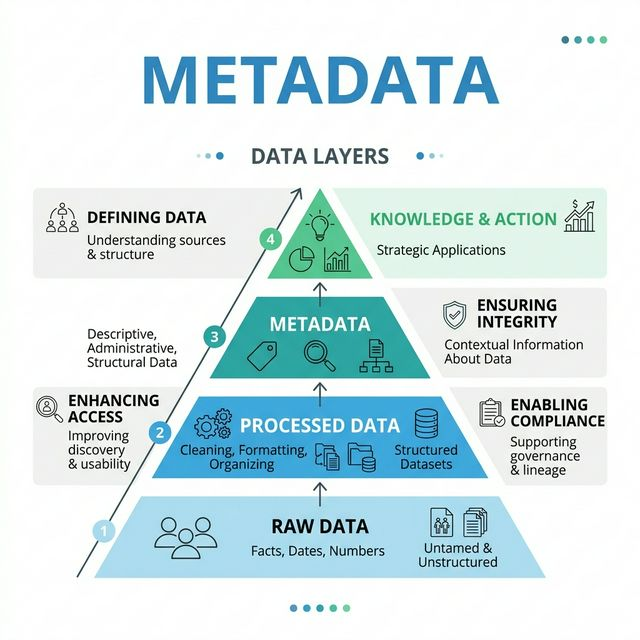
Metadata is essentially data about data. It provides context and additional information about other data, helping both humans and machines understand and manage it better. Metadata is not the content itself but provides important details that help organize, find, and interpret it. Think of it as the label on a soup can: the soup is the data, and the label containing the ingredients, expiration date, and manufacturer info is the metadata.
Common Metadata Standards: EXIF, IPTC, and XMP
In the world of digital imaging and documentation, several standards govern how metadata is structured and stored:
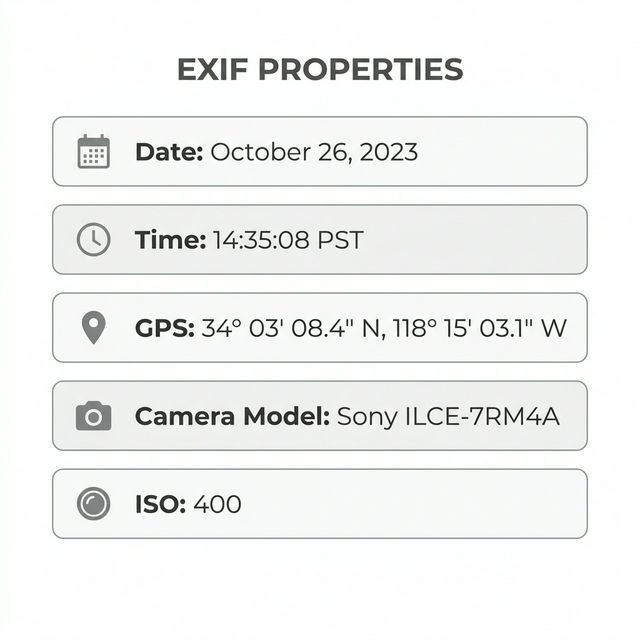
- EXIF (Exchangeable Image File Format): Specifically designed for digital cameras. it records technical data like shutter speed, aperture, ISO, and GPS coordinates.
- IPTC (International Press Telecommunications Council): Used primarily by journalists and photographers to store copyright information, captions, and keywords.
- XMP (Extensible Metadata Platform): Created by Adobe, this is a modern, XML-based standard that can wrap EXIF and IPTC data into a more flexible format, supported by almost all professional software.
Types of Metadata
Metadata comes in several types, each serving different purposes. The three primary types include:
- Descriptive Metadata: Describes the content for discovery and identification. Examples include title, author, and keywords.
- Structural Metadata: Explains how data is structured and organized, such as how pages in a PDF are ordered.
- Administrative Metadata: Includes info on the creation, technical properties, and preservation of data, such as file format and rights management.
Why Is Metadata Critical for SEO?
Metadata plays a vital role in how search engines like Google "see" your images. Since crawlers cannot actually "watch" a video or "look" at a photo in the same way humans do, they rely on embedded metadata and surrounding text to understand relevance. Properly optimized metadata can:
- Improve Image Search Rankings: Keywords in the EXIF and IPTC fields signal relevance to specific queries.
- Increase CTR (Click-Through Rate): Descriptive titles and captions appearing in rich results encourage users to click.
- Establish Authority: Proper copyright and author fields signal that the content is original and professional.
The Dark Side: Metadata and Privacy Risks
While metadata is a powerful tool for organization and SEO, it also carries significant privacy risks. Many users are unaware that every photo they share on social media or via email might contain:
- Precise GPS Location: Revealing exactly where your home, office, or children's school is located.
- Device Serial Numbers: Which can be used to track your activity across different platforms.
- Software & Usernames: Revealing the tools you use and sometimes your internal computer username.

Regularly checking your files and removing unnecessary or sensitive metadata is essential for maintaining digital safety. This is why tools like our Metadata Cleaner are so popular among privacy-conscious professionals.
Practical Examples of Metadata Use
How is metadata used in the real world? Here are a few common scenarios:
- Photography Workflow: A professional photographer uses IPTC data to embed their copyright and usage terms directly into their RAW files before delivery.
- E-commerce: An online store manager uses our Bulk Injector to add product SKUs and descriptive keywords to thousands of product images at once.
- Digital Forensics: Investigators use metadata to verify the timestamp and geographic origin of a document or photo used as evidence.
How to View and Manage Your Metadata
Most operating systems allow you to see basic metadata (right-click -> Properties on Windows, or Cmd+I on Mac). However, for professional SEO and privacy audits, these basic views are insufficient. You need a specialized tool that can parse the deep binary headers of your files. Our free Metadata Viewer provides a comprehensive report of every hidden property in your JPG, PNG, and PDF files, giving you total control over your digital footprint.
Free tool
Try it yourself — no login required
View, inject, or remove metadata from your images and PDFs free. Works on any browser.
Launch free tool →More from ProMetadata
← Back to all articles